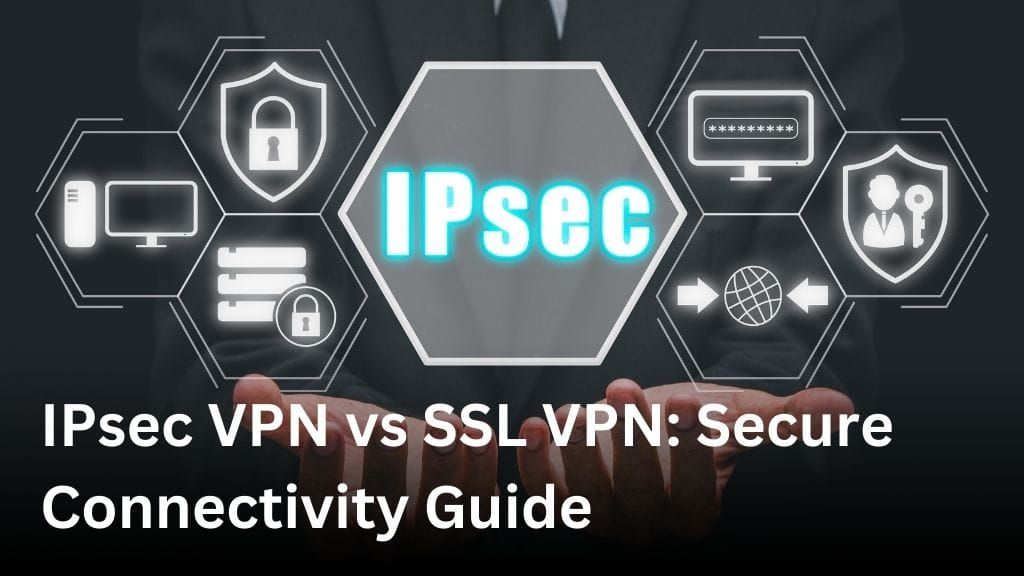
Welcome to our comprehensive guide on IPsec VPN vs SSL VPN! In an increasingly interconnected world, secure connectivity is of utmost importance. Whether you are a business owner, remote worker, or simply someone who values privacy online, understanding the differences between these two VPN technologies is vital. In this guide, we will delve into the intricacies of IPsec VPN and SSL VPN, comparing their security, performance, and encryption protocols. By the end, you’ll have all the insights needed to make an informed decision about which type of VPN is best suited for your specific needs. Understanding IPsec VPN In the realm of secure connectivity, IPsec VPN stands as a powerful solution that offers robust security features, reliable performance, and advanced encryption protocols. In this section, we will explore the intricacies of IPsec VPN and compare them with SSL VPN to highlight the unique advantages it brings to the table. Security Features IPsec VPN ensures a high level of security by establishing an encrypted tunnel between the user’s device and the remote network. This tunnel encrypts all data transmitted, protecting it from unauthorized access and potential cyber threats. IPsec VPN employs various security measures, including authentication protocols, data integrity checks, and encryption algorithms, to safeguard sensitive information. Performance Capabilities An important consideration in selecting a VPN solution is its performance capabilities. IPsec VPN boasts enhanced performance, enabling faster speeds, lower latency, and efficient bandwidth utilization. With its robust architecture and optimized protocols, IPsec VPN ensures a seamless experience for users, enabling them to transfer data quickly and effectively. Encryption Protocols IPsec VPN leverages strong encryption protocols, such as AES (Advanced Encryption Standard), to secure data transmission. These protocols ensure that any data sent or received through the VPN tunnel remains protected and confidential. With IPsec VPN, organizations can enjoy peace of mind, knowing that their sensitive data is shielded from prying eyes and potential security breaches. Table: IPsec VPN vs SSL VPN Features IPsec VPN SSL VPN Security Highly secure with strong encryption and authentication protocols Secure, but may have vulnerabilities due to the reliance on web browsers Performance Optimized for fast speeds, low latency, and efficient bandwidth utilization Dependent on the performance of the user’s web browser Encryption Uses robust encryption protocols like AES Relies on SSL/TLS protocols for encryption Protocol Uses IPsec protocol for secure communication Relies on SSL/TLS protocols for secure communication Unveiling SSL VPN In this section, we will explore SSL VPN, discussing its unique features, security measures, and performance characteristics. A comparison with IPsec VPN will be provided to help readers understand the strengths and weaknesses of SSL VPN in terms of secure connectivity. Features of SSL VPN SSL VPN, or Secure Sockets Layer Virtual Private Network, is a remote access solution that enables secure connectivity over the internet. It offers several key features that make it a popular choice for many organizations: Web-based Access: SSL VPN provides browser-based access, allowing users to securely connect to resources without requiring the installation of additional software. Application-level Access: SSL VPN provides granular control over access to specific applications or services, ensuring that users can only access the resources they need. End-to-End Encryption: SSL VPN uses SSL/TLS protocols to encrypt data in transit, ensuring that sensitive information remains secure from prying eyes. User Authentication: SSL VPN provides various authentication methods, including username and password, two-factor authentication, and certificate-based authentication, to verify the identity of users. Security Measures of SSL VPN SSL VPN incorporates a range of security measures to protect data and ensure secure connectivity: Transport Layer Security: SSL VPN uses Transport Layer Security (TLS) protocols to establish a secure connection between the user’s device and the VPN gateway. This ensures that data transmitted over the VPN is encrypted and protected. Endpoint Security: SSL VPN often includes endpoint security features such as host checking, antivirus scanning, and firewall inspection to ensure that the connecting device meets the organization’s security requirements. Granular Access Control: SSL VPN allows administrators to define access policies based on user roles, device types, or network locations, ensuring that only authorized users can access specific resources. Advanced Threat Protection: Many SSL VPN solutions offer advanced threat protection features, such as malware detection and prevention, to safeguard against malicious attacks. Performance Characteristics of SSL VPN When considering the performance of SSL VPN, several factors come into play: Bandwidth Utilization: SSL VPN typically consumes more bandwidth compared to IPsec VPN due to the overhead introduced by SSL/TLS encryption. Latency: SSL VPN may introduce additional latency due to the encryption and decryption process. While this may not be noticeable for most users, it can impact real-time applications that require low latency. Scalability: SSL VPN is generally suitable for smaller to medium-sized deployments due to its resource-intensive nature. Large-scale deployments may require additional hardware resources to handle the increased load. Cross-Platform Compatibility: SSL VPN offers broad compatibility across different operating systems and devices, making it suitable for organizations with diverse IT environments. Comparison: SSL VPN vs IPsec VPN Now let’s compare SSL VPN with IPsec VPN to better understand their differences: Criteria SSL VPN IPsec VPN Security Provides encryption at the application layer Provides encryption at the IP layer Performance May introduce more latency and higher bandwidth utilization Generally faster with lower bandwidth utilization Compatibility Compatible with a wide range of devices and operating systems Requires compatible IPsec client software Scalability Suitable for smaller to medium-sized deployments Suitable for large-scale deployments Ease of Use Web-based access without additional client software Requires installation of IPsec client software Based on these factors, organizations can choose the VPN solution that best meets their specific security, performance, and compatibility requirements. Security Comparison: IPsec VPN vs SSL VPN When it comes to choosing a VPN solution, security is of utmost importance. In this section, we will compare the security aspects of IPsec VPN and SSL VPN to help you make an informed decision based on your specific security requirements. Encryption Methods Both IPsec VPN and SSL VPN utilize encryption to protect data transmitted over