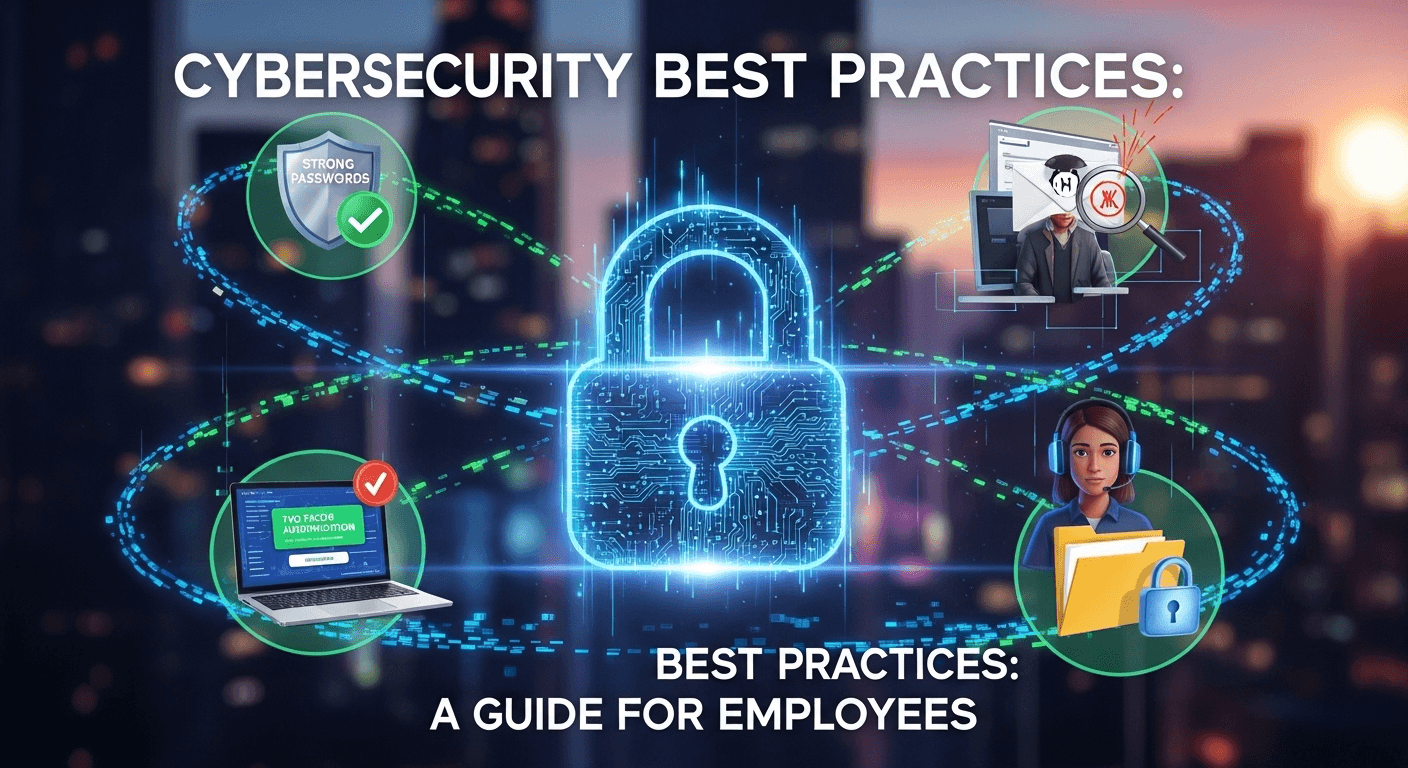
In today's digitally interconnected world, a company's greatest asset—its people—can also be its most significant vulnerability. Cybercriminals are increasingly sophisticated, realizing that hacking a human is often easier than breaching a complex network firewall. This makes every single employee a crucial part of the organization's defense strategy. Understanding and implementing effective cybersecurity best practices for employees is no longer just a recommendation from the IT department; it is a fundamental responsibility for everyone, from the intern to the CEO. This guide is designed to empower you with the knowledge and tools necessary to protect yourself, your colleagues, and the entire organization from the ever-present threat of cyberattacks. The Human Firewall: Why You Are the First Line of Defense The concept of a "human firewall" is central to modern cybersecurity. It frames employees not as a weak link, but as an active, intelligent, and essential layer of security. While technical safeguards like antivirus software, firewalls, and intrusion detection systems are critical, they can be bypassed. A clever phishing email or a moment of carelessness can render millions of dollars of security technology useless. This is where you, the employee, come into play. Your vigilance, skepticism, and adherence to security protocols create a resilient barrier that automated systems cannot replicate. Cybercriminals specifically target employees through social engineering because it exploits human psychology—trust, fear, curiosity, and a desire to be helpful. They know that an urgent-sounding email from a supposed "CEO" asking for a quick fund transfer is more likely to succeed than trying to brute-force a server's password. According to Verizon's 2023 Data Breach Investigations Report, 74% of all breaches involve the human element, including social engineering attacks, errors, or misuse. This statistic powerfully underscores why employee education and awareness are paramount. An organization is only as secure as its most unaware employee. Therefore, shifting the perspective from "employees are a risk" to "employees are a critical security asset" is transformative. When you are empowered with knowledge and feel a sense of ownership over the company's security, you become a proactive defender. Your ability to spot a suspicious email, question a strange request, or secure your workstation is not a minor task; it is a vital security function. This guide will walk you through the core principles that turn every employee into a strong link in the organizational security chain. Mastering Password and Access Management Access management is the foundation of digital security. It governs who can access what information and ensures that sensitive data is only seen by authorized individuals. At its core are passwords, the most common form of authentication. However, the way we create and manage these digital keys has a profound impact on our security. A weak or reused password is like leaving the front door of your house unlocked. In a corporate environment, the consequences are far greater, potentially leading to massive data breaches, financial loss, and reputational damage. The landscape of access management has evolved beyond just a simple username and password. The rise in credential-stuffing attacks, where attackers use lists of stolen passwords from one breach to try and log into other services, has proven that a single password is no longer sufficient for protecting high-value accounts. Think of it as a single lock on a bank vault; it's simply not enough. This has necessitated the adoption of more robust security measures. The most significant advancement in personal access security is Multi-Factor Authentication (MFA). This approach requires more than one piece of evidence—or factor—to verify your identity before granting access. By combining something you know (your password) with something you have (your phone) or something you are (your fingerprint), MFA creates a layered defense that is significantly harder for attackers to penetrate. Even if a criminal steals your password, they are stopped in their tracks because they don't have your physical device to approve the login. Creating and Managing Strong Passwords The first rule of password security is to make them strong and unique for every single account. A strong password is not just a random word with a number at the end. It is a combination of elements designed to resist both automated guessing attacks (brute-force) and human intuition. The key characteristics of a strong password include: Length: Aim for a minimum of 14 characters. Length is the single most important factor in password strength. Complexity: Use a mix of uppercase letters, lowercase letters, numbers, and symbols. Uniqueness: Never reuse passwords across different services. If one service is breached, all your accounts using that password become vulnerable. Unpredictability: Avoid using personal information like your name, birthday, pet's name, or common words like "Password123!". Remembering dozens of unique, complex passwords is an impossible task for any human. This is where a password manager becomes an indispensable tool. A password manager is a secure, encrypted application that generates, stores, and auto-fills your passwords for you. You only need to remember one strong master password to unlock your vault. Using a password manager eliminates the need to reuse passwords and enables you to create incredibly complex credentials for every site without having to memorize them. It is one of the most effective security habits you can adopt. The Non-Negotiable Role of Multi-Factor Authentication (MFA) If a strong password is the lock on your digital door, Multi-Factor Authentication (MFA), also known as Two-Factor Authentication (2FA), is the deadbolt and security chain. It operates on the principle of verifying your identity using at least two of the following three factors: Knowledge: Something only you know (e.g., your password or a PIN). Possession: Something only you have (e.g., your smartphone with an authenticator app, a physical security key). Inherence: Something you are (e.g., your fingerprint, facial recognition). Enabling MFA is arguably the single most effective action you can take to secure your accounts. Microsoft reports that implementing MFA can block over 99.9% of account compromise attacks. When you log in with your password, the service will then prompt you for a second factor, such as a one-time code from