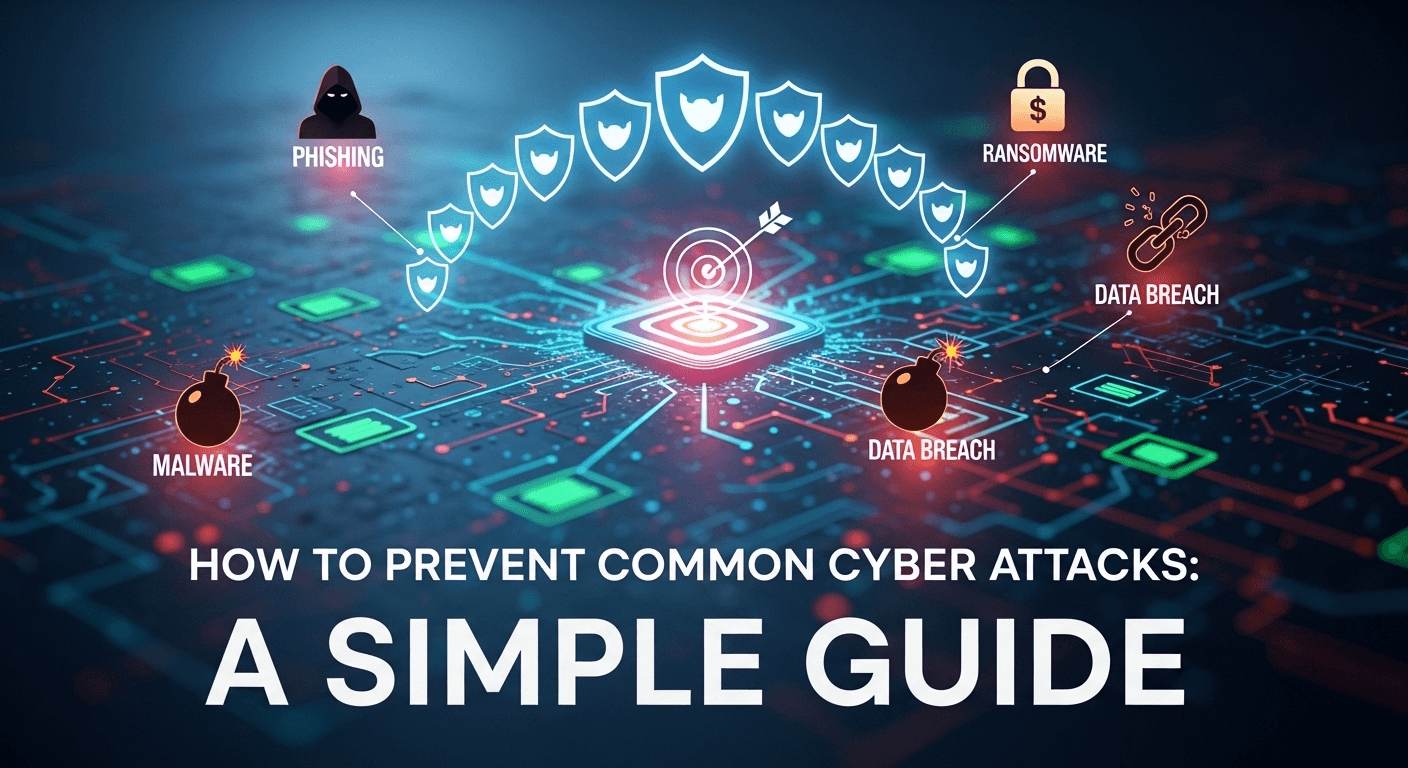
How to Prevent Common Cyber Attacks: A Simple Guide Cyber attacks are becoming more frequent and sophisticated, but many successful breaches still exploit basic weaknesses. If you want to learn how to prevent common cyber attacks, start with strong fundamentals: understand threats, secure devices and networks, protect identities and data, prepare to respond, and build a security-first culture. This guide lays out practical, long-term strategies that anyone—from individuals to small businesses—can implement to reduce risk and recover faster when incidents occur. Understanding the landscape and applying layered defenses are essential. Below you’ll find clear steps, real-world best practices, and an easy-reference table to compare threats and countermeasures. Follow these recommendations to raise your security baseline and make it far more difficult for attackers to succeed. Understand Common Cyber Threats Knowing the enemy is the first step in how to prevent common cyber attacks. Attackers use a range of techniques—phishing, malware, ransomware, credential theft, and denial-of-service—to reach their goals. Many successful breaches begin with a simple social-engineering trick, so technical controls must be paired with user awareness. A practical approach is to categorize threats by vector (email, web, network, physical), motive (financial, espionage, disruption), and likely targets (individuals, SMBs, enterprises). By mapping your organization’s assets against that threat profile, you can prioritize defenses where they reduce the most risk. Prioritization saves time and budget and ensures high-impact assets get layered protection first. Finally, keep threat intelligence current. Subscribe to reputable feeds, review vendor advisories, and learn from public breaches. Understanding who might target you and why helps tailor controls and incident responses to realistic scenarios rather than hypothetical extremes. Phishing and Social Engineering Phishing remains the top initial access vector for many breaches. Attackers craft convincing emails, messages, or phone calls to trick users into revealing credentials, clicking malicious links, or approving fraudulent transactions. Modern phishing often uses impersonation of trusted services and urgency to bypass rational checks. To combat this, implement both technical and human controls. Technical measures include email filtering, DMARC/DKIM/SPF for authentication, and safe-link rewriting for URL scanning. Human measures include regular phishing simulations and training that focus on recognizing contextual clues—unexpected requests for credentials, mismatched domains, and unusual grammar or tone. People are a security control; empower them. Malware and Ransomware Malware (including ransomware) is delivered via email attachments, drive-by downloads, infected installers, or compromised remote access tools. Ransomware often gains a foothold through a single compromised account or an unpatched remote service and then escalates privileges and spreads laterally. Defenses include modern endpoint protection (EPP/EDR), application allow-lists, timely patching, and restricting administrative rights. Equally important are backups and tested recovery processes. Backups that are not tested or are continuously accessible to the attacker are useless, so isolate and validate backups regularly. Secure Networks and Endpoints Securing the network is not a one-off configuration; it’s a continuous discipline. Use segmentation, strong perimeter controls, and modern detection systems to limit attacker movement and speed detection. Cloud and hybrid environments require consistent policy enforcement across on-premises and cloud resources. Start by creating network zones that isolate critical assets. Put user devices on separate VLANs from servers and management interfaces. Use next-generation firewalls, intrusion detection/prevention systems (IDS/IPS), and limit inbound remote access with VPNs or secure gateways. Assume the internal network will be probed—reduce the number of accessible services. Finally, keep endpoint protection up to date. Modern EDR solutions not only block known malware but also detect suspicious behavior patterns. Combine behavioral detection with threat hunting to find hidden intrusions early. Firewalls, Segmentation, and VPNs Firewalls should enforce least-privilege network flows rather than open wide permissive rules. Network segmentation reduces blast radius: if one device is compromised, the attacker cannot easily access unrelated systems. Microsegmentation in cloud environments provides more granular control for critical workloads. VPNs are useful but can be a single point of failure if misconfigured or if credentials are weak. Consider replacing or augmenting VPNs with Zero Trust Network Access (ZTNA) solutions that grant access based on identity, device posture, and context. Segment and verify on every connection. Endpoint Protection and Patch Management Endpoint defenses require continuous maintenance: patching operating systems, browsers, and third-party apps, and deploying agents that can detect malicious activities. Implement centralized patch management and prioritize critical updates that mitigate high-risk vulnerabilities. Also deploy application control and principle-of-least-privilege for applications. Restrict admin privileges and use endpoint encryption for data-at-rest. Combine these with logging and centralized telemetry to quickly investigate suspicious events. Protect Identities and Access Compromised credentials are a leading cause of breaches. Strong identity security reduces both the likelihood and impact of attacks. Implement multi-factor authentication (MFA), strong password policies, and account lifecycle management to secure identities from creation to deprovisioning. Beyond MFA, adopt a least-privilege access model. Regularly review permissions, automate access approvals, and revoke rights when roles change. Use single sign-on (SSO) judiciously and monitor SSO activity for anomalies. Finally, treat service accounts like human accounts: give them the minimal privileges, rotate keys, and monitor their usage. Identity is the new perimeter—protect it accordingly. Multi-factor Authentication (MFA) MFA adds a second verification layer—something you have (token), something you know (PIN), or something you are (biometrics). It significantly reduces the risk of account takeover even if passwords are leaked. Use phishing-resistant MFA (hardware tokens, FIDO2/WebAuthn) for high-privilege accounts. Enforce MFA across all remote access and privileged operations. Ensure backup MFA methods are secure, and educate users about MFA fatigue or social engineering that attempts to bypass MFA. Least Privilege and Access Reviews Least privilege limits what accounts can do and access. Implement role-based access control (RBAC), periodic access reviews, and time-limited elevated access (just-in-time, JIT). Automate onboarding and offboarding to avoid orphaned accounts. Conduct quarterly or monthly audits of privileged accounts and require justification for continued access. Revoking unnecessary access is one of the most effective risk reducers. Application and Data Security Applications are a frequent attack target—vulnerabilities in web apps or APIs can provide remote code execution or data exposure. Secure development practices prevent vulnerabilities before deployment and reduce remediation