How to Prevent Common Cyber Attacks: A Simple Guide
Cyber attacks are becoming more frequent and sophisticated, but many successful breaches still exploit basic weaknesses. If you want to learn how to prevent common cyber attacks, start with strong fundamentals: understand threats, secure devices and networks, protect identities and data, prepare to respond, and build a security-first culture. This guide lays out practical, long-term strategies that anyone—from individuals to small businesses—can implement to reduce risk and recover faster when incidents occur.
Understanding the landscape and applying layered defenses are essential. Below you’ll find clear steps, real-world best practices, and an easy-reference table to compare threats and countermeasures. Follow these recommendations to raise your security baseline and make it far more difficult for attackers to succeed.
Understand Common Cyber Threats
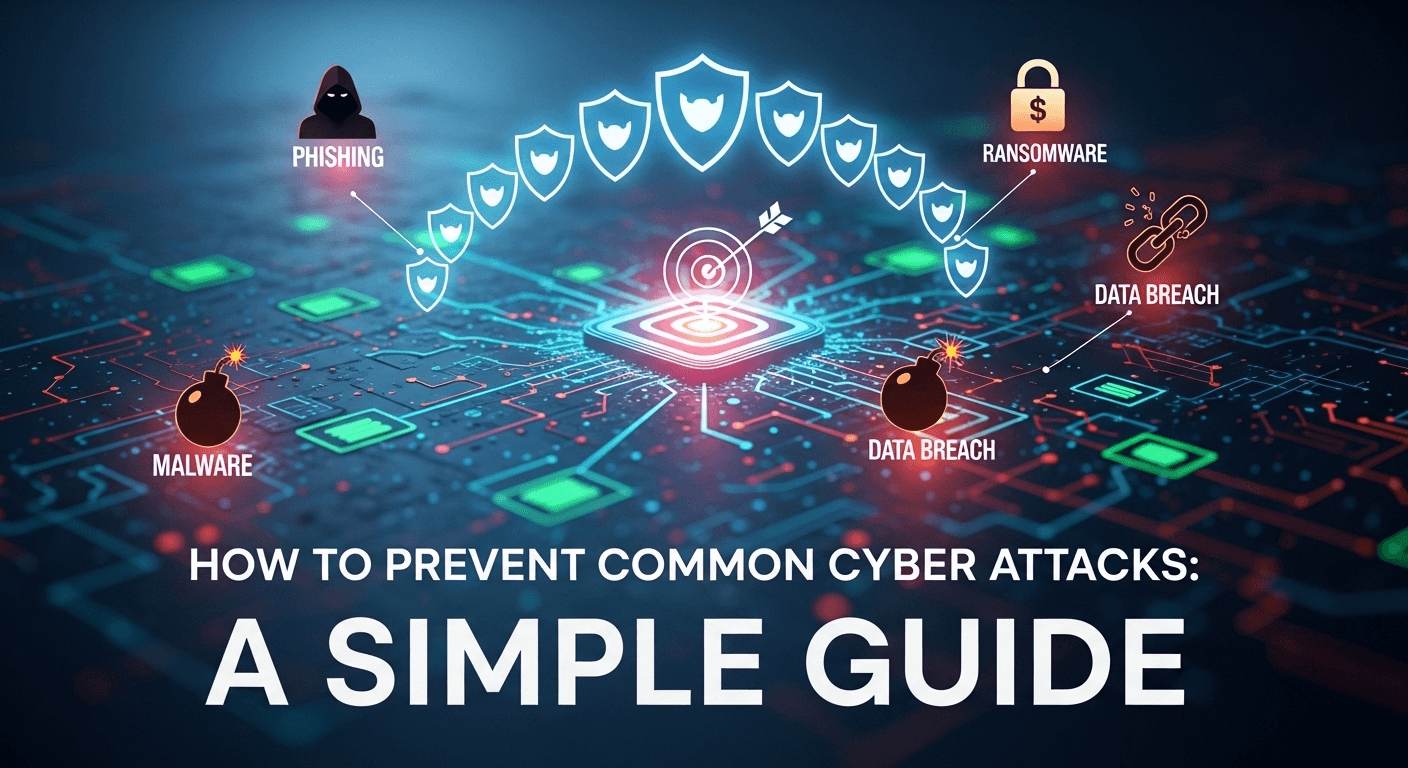
Knowing the enemy is the first step in how to prevent common cyber attacks. Attackers use a range of techniques—phishing, malware, ransomware, credential theft, and denial-of-service—to reach their goals. Many successful breaches begin with a simple social-engineering trick, so technical controls must be paired with user awareness.
A practical approach is to categorize threats by vector (email, web, network, physical), motive (financial, espionage, disruption), and likely targets (individuals, SMBs, enterprises). By mapping your organization’s assets against that threat profile, you can prioritize defenses where they reduce the most risk. Prioritization saves time and budget and ensures high-impact assets get layered protection first.
Finally, keep threat intelligence current. Subscribe to reputable feeds, review vendor advisories, and learn from public breaches. Understanding who might target you and why helps tailor controls and incident responses to realistic scenarios rather than hypothetical extremes.
Phishing and Social Engineering
Phishing remains the top initial access vector for many breaches. Attackers craft convincing emails, messages, or phone calls to trick users into revealing credentials, clicking malicious links, or approving fraudulent transactions. Modern phishing often uses impersonation of trusted services and urgency to bypass rational checks.
To combat this, implement both technical and human controls. Technical measures include email filtering, DMARC/DKIM/SPF for authentication, and safe-link rewriting for URL scanning. Human measures include regular phishing simulations and training that focus on recognizing contextual clues—unexpected requests for credentials, mismatched domains, and unusual grammar or tone. People are a security control; empower them.
Malware and Ransomware
Malware (including ransomware) is delivered via email attachments, drive-by downloads, infected installers, or compromised remote access tools. Ransomware often gains a foothold through a single compromised account or an unpatched remote service and then escalates privileges and spreads laterally.
Defenses include modern endpoint protection (EPP/EDR), application allow-lists, timely patching, and restricting administrative rights. Equally important are backups and tested recovery processes. Backups that are not tested or are continuously accessible to the attacker are useless, so isolate and validate backups regularly.
Secure Networks and Endpoints
Securing the network is not a one-off configuration; it’s a continuous discipline. Use segmentation, strong perimeter controls, and modern detection systems to limit attacker movement and speed detection. Cloud and hybrid environments require consistent policy enforcement across on-premises and cloud resources.
Start by creating network zones that isolate critical assets. Put user devices on separate VLANs from servers and management interfaces. Use next-generation firewalls, intrusion detection/prevention systems (IDS/IPS), and limit inbound remote access with VPNs or secure gateways. Assume the internal network will be probed—reduce the number of accessible services.
Finally, keep endpoint protection up to date. Modern EDR solutions not only block known malware but also detect suspicious behavior patterns. Combine behavioral detection with threat hunting to find hidden intrusions early.
Firewalls, Segmentation, and VPNs
Firewalls should enforce least-privilege network flows rather than open wide permissive rules. Network segmentation reduces blast radius: if one device is compromised, the attacker cannot easily access unrelated systems. Microsegmentation in cloud environments provides more granular control for critical workloads.
VPNs are useful but can be a single point of failure if misconfigured or if credentials are weak. Consider replacing or augmenting VPNs with Zero Trust Network Access (ZTNA) solutions that grant access based on identity, device posture, and context. Segment and verify on every connection.
Endpoint Protection and Patch Management
Endpoint defenses require continuous maintenance: patching operating systems, browsers, and third-party apps, and deploying agents that can detect malicious activities. Implement centralized patch management and prioritize critical updates that mitigate high-risk vulnerabilities.
Also deploy application control and principle-of-least-privilege for applications. Restrict admin privileges and use endpoint encryption for data-at-rest. Combine these with logging and centralized telemetry to quickly investigate suspicious events.
Protect Identities and Access
Compromised credentials are a leading cause of breaches. Strong identity security reduces both the likelihood and impact of attacks. Implement multi-factor authentication (MFA), strong password policies, and account lifecycle management to secure identities from creation to deprovisioning.
Beyond MFA, adopt a least-privilege access model. Regularly review permissions, automate access approvals, and revoke rights when roles change. Use single sign-on (SSO) judiciously and monitor SSO activity for anomalies.
Finally, treat service accounts like human accounts: give them the minimal privileges, rotate keys, and monitor their usage. Identity is the new perimeter—protect it accordingly.
Multi-factor Authentication (MFA)
MFA adds a second verification layer—something you have (token), something you know (PIN), or something you are (biometrics). It significantly reduces the risk of account takeover even if passwords are leaked. Use phishing-resistant MFA (hardware tokens, FIDO2/WebAuthn) for high-privilege accounts.
Enforce MFA across all remote access and privileged operations. Ensure backup MFA methods are secure, and educate users about MFA fatigue or social engineering that attempts to bypass MFA.
Least Privilege and Access Reviews
Least privilege limits what accounts can do and access. Implement role-based access control (RBAC), periodic access reviews, and time-limited elevated access (just-in-time, JIT). Automate onboarding and offboarding to avoid orphaned accounts.
Conduct quarterly or monthly audits of privileged accounts and require justification for continued access. Revoking unnecessary access is one of the most effective risk reducers.
Application and Data Security
Applications are a frequent attack target—vulnerabilities in web apps or APIs can provide remote code execution or data exposure. Secure development practices prevent vulnerabilities before deployment and reduce remediation costs.
Adopt secure SDLC practices: threat modeling, static/dynamic code analysis, and regular penetration testing. Use dependency scanning to catch vulnerable libraries and enforce secure configuration baselines for frameworks and containers.
Protect data at every stage: classification, handling, storage, and disposal. Encrypt sensitive data in transit and at rest, maintain strict key management, and apply tokenization or masking where applicable. If data is classified and protected properly, an exposed system may be less damaging.

Secure Development and Code Reviews
Secure coding practices catch common flaws like injection, authentication bypass, and insecure deserialization. Integrate security testing into CI/CD pipelines using SAST (static), DAST (dynamic), and SCA (software composition analysis).
Peer code reviews and automated checks reduce human error. Treat security findings as part of the release criteria; do not ship high or critical severity vulnerabilities to production.
Encryption and Data Handling
Use TLS for all external and internal communications. Encrypt databases and storage volumes containing sensitive information. Manage encryption keys using centralized, auditable systems such as Hardware Security Modules (HSM) or cloud KMS.
Define data retention and deletion policies to minimize the amount of sensitive data stored. Apply data-loss prevention (DLP) controls to prevent unauthorized exfiltration.
Prepare for Incidents and Build Resilience
Despite prevention, incidents can and will happen. Preparing ahead of time reduces confusion and shortens recovery time. An incident response plan (IRP) assigns roles, communication channels, and step-by-step actions to isolate and remediate incidents.
Test your IRP with tabletop exercises and simulated attacks. Practice helps teams learn coordination and uncovers gaps in tools or escalation paths. Include legal, PR, and business stakeholders in exercises to align response priorities.
Recovery depends on reliable backups and validated recovery procedures. Maintain offline or immutable backups, document recovery runbooks, and regularly measure recovery time objectives (RTO) and recovery point objectives (RPO).
Incident Response Planning and Playbooks
Incident response playbooks should specify detection triggers, containment actions, and evidence preservation steps. Define escalation criteria and notification templates for internal teams and external stakeholders, including regulators if necessary.
Assign roles (incident commander, technical lead, communications lead) and create a decision matrix for containment vs. business continuity. Make playbooks concise and actionable; complexity slows response.
Backups, Recovery, and Business Continuity
Backups should be regular, tested, and isolated to prevent attacker tampering. Use immutability or air-gapped solutions and verify restoration from snapshots or backups frequently.
Create business continuity plans for critical services, and prioritize restoring functions that maximize customer impact mitigation. Recovery is not complete until normal operations and security posture are restored and lessons are integrated.
People, Policies, and Continuous Improvement
Technology alone won't stop attacks—people and policies create sustainable security. A security-aware culture encourages cautious behavior, prompt reporting of suspicious activity, and compliance with safeguards.
Implement clear policies for acceptable use, incident reporting, and remote work. Provide targeted training aligned with roles: developers learn secure coding; finance teams learn invoice fraud detection; executives learn risk tolerance and incident communications.
Measure effectiveness through metrics: phishing click rates, mean time to detect (MTTD), mean time to respond (MTTR), patch compliance, and access review completion. Use these metrics to prioritize investments and communicate security ROI to leadership.
Security Awareness Training
Training should be continuous, contextual, and measured. Short, frequent modules and simulated phishing campaigns improve retention better than annual all-hands sessions. Reward reporting of suspicious emails to encourage proactive behavior.
Tailor training to common threats each role faces and test practical application, not only theory. Use positive reinforcement: show how a reported phishing email prevented a breach in simulations.
Metrics, Audits, and Continuous Monitoring
Collect and review telemetry from endpoints, networks, and cloud services. Use security information and event management (SIEM) or cloud-native monitoring to aggregate logs and trigger alerts. Regular audits validate controls and identify drift.
Continuous improvement means adjusting controls based on incidents and threat intelligence. Conduct post-incident reviews with candid root-cause analysis and incorporate lessons into policies and technology.
Table: Common Cyber Attacks — Vectors, Impact, and Key Preventive Controls
| Attack Type | Common Vector(s) | Typical Impact | Key Preventive Controls |
|---|---|---|---|
| Phishing/Social Engineering | Email, SMS, Voice | Credential theft, fraud | Email auth (DMARC/DKIM/SPF), phishing training, MFA |
| Ransomware | Phishing, RDP, unpatched services | Data encryption, downtime, extortion | Backups (immutable), EDR, patching, network segmentation |
| Malware (Trojans, Worms) | Email, malicious downloads | Data theft, persistence | EPP/EDR, app allow-lists, user education |
| Credential Stuffing | Leaked passwords, automated bots | Unauthorized access | MFA, rate limiting, password hygiene, SSO monitoring |
| Web Application Attacks | SQLi, XSS, insecure APIs | Data leakage, remote compromise | Secure SDLC, WAF, input validation, pen testing |
Bullet/Numbered Summary: Quick Actions to Improve Security Now
- Enable MFA on all accounts—use phishing-resistant options where possible.
- Patch critical systems and prioritize internet-facing services.
- Deploy endpoint detection and response (EDR) on all devices.
- Implement backups with isolation and test restores monthly.
- Run phishing simulations and targeted security training.
- Enforce least privilege and automate access reviews.
- Maintain a tested incident response plan with clear roles.
FAQ (Q & A)
Q: What is the single most effective action to reduce cyber risk?
A: Enable multi-factor authentication (MFA) across all accounts and ensure privileged accounts use phishing-resistant methods (hardware tokens or FIDO2). MFA drastically reduces account takeover risk even if passwords are leaked.
Q: How often should I patch and update systems?
A: Patch critical and high-severity vulnerabilities immediately or within 48-72 hours if possible. For regular updates, follow a monthly cadence for routine patches and maintain emergency procedures for zero-day or active-exploit vulnerabilities.
Q: Are backups enough to protect against ransomware?
A: Backups are necessary but not sufficient alone. They must be immutable, isolated, tested, and combined with detection, segmentation, and endpoint defenses. Also validate backups by performing regular restores.
Q: Should small businesses invest in expensive security tools?
A: Small businesses should prioritize controls that deliver the most risk reduction per dollar: MFA, patching, backups, and endpoint protection. Many cloud providers offer built-in security features that are cost-effective when used properly.
Q: How do I measure security improvements?
A: Track metrics such as phishing click rate, patch compliance, time to apply critical patches, MTTD (mean time to detect), and MTTR (mean time to respond). Use these KPIs to guide investments and report progress.
Conclusion
Preventing common cyber attacks requires a layered, pragmatic approach: understand threats, secure networks and endpoints, protect identities, harden applications and data, prepare for incidents, and cultivate security-aware people and policies. There is no silver bullet, but a combination of prioritized technical controls, regular training, and tested incident response greatly reduces both the likelihood and the impact of attacks. Start with high-impact, low-cost measures—MFA, patching, backups, and user education—and build from there using metrics and lessons learned to continuously improve.
Summary (English)
This guide, "How to Prevent Common Cyber Attacks: A Simple Guide," explains practical steps for reducing cyber risk across people, processes, and technology. It covers common threats (phishing, malware, ransomware), network and endpoint security best practices, identity and access controls like MFA and least privilege, application/data protection, incident response planning, and the role of training and metrics. The article includes a comparison table of attacks and preventive controls, a quick-action checklist, and a Q&A covering key concerns. Focus first on high-impact controls—MFA, patching, reliable backups, endpoint protection, and phishing simulations—then iterate using measurable metrics to strengthen resilience over time.