In our hyper-connected world, our devices are extensions of ourselves. From smartphones that manage our daily schedules to laptops that hold our most sensitive work documents, we entrust an incredible amount of personal and professional data to these digital tools. This deep reliance, however, opens the door to a pervasive and often invisible threat. Understanding the answer to the critical question of what is malware and how to prevent it is no longer a task for IT professionals alone; it’s a fundamental skill for anyone who uses a computer, tablet, or smartphone. This comprehensive guide will walk you through the world of malicious software, equipping you with the knowledge to protect your digital life.
What Exactly Is Malware? A Deep Dive
Malware, a portmanteau of “malicious software,” is an umbrella term that refers to any software or mobile application intentionally designed to cause damage to a computer, server, client, or computer network. Unlike a program that has an accidental bug, malware is created with malicious intent. Its creators, often referred to as cybercriminals or threat actors, have a wide range of motivations, from financial gain and corporate espionage to simple disruption or activism. The primary goal is almost always to compromise the confidentiality, integrity, or availability of a user’s data or device.
It’s crucial to understand that “malware” is a broad category, not a single type of threat. While many people use the term “virus” interchangeably with malware, a virus is just one specific type of malicious program. The malware ecosystem is vast and varied, encompassing everything from software that spies on your every move to programs that hold your files hostage for a ransom. It can be designed to steal login credentials, siphon money from bank accounts, use your device’s resources to mine cryptocurrency, or turn your computer into a “zombie” to attack other systems.
The sophistication of malware is constantly evolving. In its early days, malware often spread through floppy disks and had relatively simple, albeit destructive, functions. Today, malware is a complex and lucrative business. It spreads through sophisticated methods like phishing emails that look identical to legitimate communications, malicious advertisements on trusted websites (malvertising), and bundled downloads with seemingly harmless free software. Its ability to hide, replicate, and adapt makes it a persistent and formidable threat to individuals and organizations alike.
The Common Culprits: Types of Malware You Should Know
To effectively defend against malware, you must first understand your enemy. Knowing the different forms malware can take helps you recognize potential threats and understand the specific risks associated with each. Here are some of the most prevalent types of malware circulating today.
Viruses
A computer virus is a type of malware that, when executed, replicates itself by modifying other computer programs and inserting its own code. It requires a host program to spread, much like a biological virus needs a host cell. When the host program is run, the viral code is executed first, which can then cause damage, steal information, or simply continue to spread to other files on the same computer or other computers on the same network.
For a virus to infect your device, it requires human action. This action could be as simple as opening a malicious email attachment (like a `.exe` file disguised as a PDF) or running an infected program downloaded from an untrustworthy source. Once active, a virus can do anything from corrupting or deleting data to rendering the entire system inoperable. Famous examples include the ILOVEYOU virus, which spread rapidly via email in the early 2000s, causing billions of dollars in damages.
Worms
Unlike viruses, worms are standalone pieces of malware that can replicate and spread independently without needing a host program or human intervention. They typically exploit vulnerabilities in an operating system or software application to move from one computer to another across a network. This self-propagating nature makes them incredibly dangerous and allows them to spread at an exponential rate.
Once a worm infects a device, it will scan the network for other vulnerable machines to infect. This can quickly lead to massive network congestion and widespread disruption. A classic example is the Conficker worm, which infected millions of computers worldwide by exploiting a vulnerability in a Windows service. Worms are often used to create botnets—networks of infected computers that can be controlled remotely by an attacker to launch large-scale attacks, such as Distributed Denial of Service (DDoS) attacks.
Trojans (Trojan Horses)
Named after the ancient Greek story of the wooden horse used to breach the city of Troy, a Trojan Horse is a type of malware that disguises itself as legitimate or useful software. An unsuspecting user is tricked into downloading and executing it on their system. Once installed, the Trojan opens a “backdoor,” allowing a remote attacker to gain unauthorized access to the infected computer.
Trojans themselves are not typically self-replicating. Their primary function is to deliver another malicious payload or to give an attacker persistent access. This access can be used to steal sensitive data (like passwords and financial information), install other forms of malware (like ransomware or spyware), modify or delete files, or monitor user activity. For instance, a user might download what they think is a free game or utility, but running the program also secretly installs a keylogger that records their keystrokes.
Ransomware
Ransomware is one of the most notorious and financially damaging types of malware. It works by encrypting the victim’s files or locking them out of their entire system. The attackers then demand a ransom payment, typically in cryptocurrency like Bitcoin, in exchange for the decryption key or to restore access. There is no guarantee that paying the ransom will result in the recovery of the files; the criminals may simply take the money and disappear.
This type of malware often spreads through phishing emails containing malicious attachments or links to compromised websites. A famous example is the WannaCry ransomware attack in 2017, which crippled hospitals, banks, and government agencies across the globe. The best defense against ransomware is having regular, secure, and offline backups of your important data, as this allows you to restore your files without paying the criminals.
Spyware
Spyware is malware designed to secretly observe the computer user’s activities without their knowledge or consent and report that data to the software’s author. It operates in the background, collecting a vast array of information. This can include browsing habits, login credentials, credit card numbers, email messages, and any other sensitive data entered or stored on the device.
One common form of spyware is a keylogger, which records every keystroke you make. This information is then sent to the attacker, providing them with everything from private conversations to online banking passwords. Spyware is often bundled with free software (freeware or shareware) and can be difficult to detect since its goal is to remain hidden. The primary danger of spyware is the severe violation of privacy and the high risk of identity theft and financial fraud.
How Does Malware Infect Your Devices? Common Attack Vectors
Malware doesn’t just magically appear on your devices; it has to get there somehow. The pathways it uses to infiltrate a system are known as “attack vectors.” Understanding these common entry points is critical for building a robust defense strategy. Cybercriminals are constantly refining these methods to exploit both technical vulnerabilities and human psychology.
One of the most effective and widely used attack vectors is phishing and social engineering. This method relies on deception rather than technical prowess. Attackers send emails, text messages (a practice known as smishing), or social media messages that appear to be from a legitimate source, such as a bank, a well-known company, or even a colleague. These messages are crafted to create a sense of urgency or curiosity, prompting the user to click a malicious link or download an infected attachment. For example, an email might claim there’s a problem with your account and direct you to a fake login page designed to steal your credentials.
Another primary vector is malicious downloads and compromised software. This includes downloading software from untrusted websites, torrent sites, or peer-to-peer (P2P) networks. These programs, often marketed as “cracked” or free versions of paid software, are frequently bundled with malware. Even legitimate-looking attachments in emails, such as invoices, shipping notifications, or résumés, can be weaponized Word documents or PDFs that execute malicious code when opened. Similarly, malvertising involves injecting malicious code into digital ads on legitimate websites, which can redirect you to a malicious site or trigger a malware download without you even clicking the ad.
Finally, exploiting software vulnerabilities and unsecured networks is a key method for malware propagation, especially for worms. Operating systems and applications are complex, and they can have security flaws or “vulnerabilities.” Attackers actively search for these flaws and create “exploits” to take advantage of them. If you fail to install security patches and updates promptly, your device remains vulnerable. Additionally, connecting to unsecured public Wi-Fi networks (e.g., in cafes, airports) can expose your device. Attackers on the same network can intercept your traffic or try to directly inject malware onto your device if its defenses are weak.
Proactive Prevention: Your First Line of Defense
The best way to deal with malware is to prevent it from infecting your devices in the first place. A proactive, multi-layered security approach is far more effective than trying to clean up an infection after the fact. This involves a combination of using the right tools and cultivating safe digital habits.
Use Comprehensive Antivirus/Antimalware Software
This is your foundational layer of protection. A reputable antivirus (AV) or antimalware program is designed to detect, block, and remove malicious software. Modern security suites go beyond simple signature-based detection (matching files against a database of known malware) and use heuristics and behavioral analysis to identify new and unknown threats. This software actively scans files you download, websites you visit, and emails you receive.
Ensure your security software is from a trusted and well-reviewed vendor like Bitdefender, Norton, Kaspersky, or Malwarebytes. Once installed, it is absolutely critical to keep it running and allow it to update its virus definitions automatically. An outdated antivirus program is like a lock with a widely known key; it provides a false sense of security. Schedule regular full system scans to catch any threats that might have slipped through real-time protection.
Keep Your Software and Operating System Updated
Malware like worms and some Trojans often exploit known security vulnerabilities in your operating system (Windows, macOS, Android, iOS) and applications (like your web browser, PDF reader, or office suite). Software developers regularly release security patches and updates to fix these vulnerabilities as they are discovered. By delaying these updates, you are leaving a known backdoor open for attackers.
Enable automatic updates for your operating system and your key applications whenever possible. When a program prompts you to install an update, do not ignore it. This simple habit is one of the most effective ways to protect your system from a wide range of automated attacks. It’s the digital equivalent of fixing a broken window on your house to keep intruders out.
Practice Safe Browsing Habits
Your behavior online plays a significant role in your security. Be mindful of the websites you visit. Stick to well-known, reputable sites and be wary of links that seem suspicious. Use a web browser with built-in security features that can warn you about potentially dangerous websites or downloads. Consider using a browser extension like a script blocker or an ad blocker, as these can prevent malicious ads (malvertising) and scripts from running.
Furthermore, be extremely cautious about what you download. Only download software from official sources—the developer’s website or a legitimate app store (like the Apple App Store or Google Play Store). Avoid pirated software, “cracked” games, and downloads from P2P file-sharing networks, as these are notorious hotbeds for malware. Before clicking “download,” ask yourself if you trust the source completely.
Be Skeptical of Emails and Messages
Phishing remains a top vector for malware delivery. Treat every unsolicited email, text, and social media message with a healthy dose of skepticism. Do not click on links or download attachments from unknown senders. Even if an email appears to be from a known contact or company, be cautious. Attackers can “spoof” email addresses to make them look legitimate.
Look for red flags: generic greetings (“Dear Customer”), spelling and grammar mistakes, a sense of extreme urgency (“Your account will be suspended in 24 hours!”), or requests for sensitive information. If an email from your bank asks you to click a link to verify your account, don’t click it. Instead, open your browser, manually type in your bank’s official website address, and log in from there to check for any notifications.
Use Strong, Unique Passwords and Two-Factor Authentication (2FA)
While not a direct defense against downloading malware, strong account security prevents attackers from easily gaining access to your online accounts if your credentials are ever stolen by spyware or a data breach. Use a long, complex password (a mix of upper/lowercase letters, numbers, and symbols) for each of your important accounts. Better yet, use a reputable password manager to generate and store unique, strong passwords for all your online services.
Wherever possible, enable two-factor authentication (2FA) or multi-factor authentication (MFA). This adds a crucial second layer of security. Even if an attacker steals your password, they will not be able to log in without the second factor, which is typically a code sent to your phone or generated by an authenticator app. This simple step can block the vast majority of account takeover attempts.
Recognizing the Red Flags: Signs of a Malware Infection
Sometimes, despite our best efforts, malware can find its way onto a device. Detecting an infection early can significantly limit the damage. While some malware is designed to be stealthy, it often leaves behind telltale signs. Learning to recognize these red flags can alert you to a problem.
Key symptoms of a malware infection include:
- Sudden performance degradation: Your computer or phone becomes extremely slow, freezes, or crashes frequently.
- Unwanted pop-up ads: You are bombarded with advertisements, even when you are not browsing the web.
- Browser redirects and homepage changes: Your web browsers homepage is changed without your permission, or you are redirected to websites you didnt intend to visit.
- New, unfamiliar toolbars, extensions, or icons: You notice new toolbars in your browser or strange icons on your desktop that you did not install.
- Rapid battery drain: Your laptop or smartphone battery depletes much faster than usual.
- Unexplained network activity: You notice a spike in your internet data usage, or your computers fan runs constantly, even when its idle.
- Security software being disabled: Your antivirus or firewall suddenly turns off on its own and you cannot re-enable it.
- Files are missing, modified, or encrypted: You cant access your files, or you find a ransom note.
It’s important to investigate any of these symptoms promptly. While a slow computer isn’t always a sign of malware (it could be due to a lack of disk space or too many programs running), a combination of these signs is a strong indicator of an infection. Running a full system scan with your antimalware software should be your immediate first step if you suspect a problem.
The following table provides a quick comparison to help you distinguish between normal device behavior and potential signs of malware.
| Feature | Normal Device Behavior | Potential Malware Symptom |
|---|---|---|
| Performance | Runs smoothly, occasional slowdowns when running heavy applications. | Suddenly becomes very slow, freezes frequently, crashes with “blue screen” errors. |
| Advertisements | Seen on websites that serve ads. | Constant, intrusive pop-up ads appearing on the desktop, even without a browser open. |
| Browser | Homepage and search engine remain as you set them. | Homepage or default search engine changes without your input; frequent redirects. |
| Data Usage | Spikes when streaming video, downloading large files, or updating software. | High network activity and data usage even when the device is idle. |
| Files | Files are accessible and unchanged unless you modify them. | Files are suddenly encrypted, deleted, or you find new, strange files on your system. |
| Battery Life | Depletes at a predictable rate based on usage. | Drastic and sudden decrease in battery life with no change in usage patterns. |
Conclusion: Staying Vigilant in a Digital World
In the end, understanding what malware is and how to prevent it comes down to a simple, powerful principle: vigilance. The digital landscape is in a constant state of flux, with new threats emerging as old ones are neutralized. Relying on a single tool or a single habit is not enough. True digital security is a holistic practice that combines robust technological defenses with smart, cautious online behavior.
By installing and maintaining comprehensive antimalware software, consistently updating your operating system and applications, and adopting habits like scrutinizing emails and using strong, unique passwords with 2FA, you create multiple layers of defense. This makes it significantly harder for an attacker to succeed. Remember that you are the ultimate gatekeeper for your devices. No software can fully protect you if you willingly open the door to a threat.
Treat your digital security with the same seriousness you apply to your physical security. By staying informed, remaining skeptical, and being proactive, you can navigate the digital world with confidence, keeping your valuable data and personal information safe from the ever-present threat of malware.
Frequently Asked Questions (FAQ)
Q1: Can my Mac or iPhone get malware?
A: Yes. While it’s true that Apple’s macOS and iOS have strong built-in security and historically have been targeted less than Windows and Android, they are not immune to malware. Phishing attacks, which trick users into giving up credentials, work on any platform. Malicious apps can sometimes slip through the App Store’s review process, and dedicated malware for macOS definitely exists. It’s a dangerous misconception to believe any device is “invincible.”
Q2: Is free antivirus software good enough?
A: Reputable free antivirus software (like the built-in Microsoft Defender on Windows or free versions from companies like Avast or AVG) provides a decent baseline of protection against common threats. However, paid security suites typically offer more advanced features, such as enhanced ransomware protection, firewall controls, phishing protection, and parental controls. For users who handle highly sensitive data or want the most comprehensive protection, a paid version is often a worthwhile investment.
Q3: Whats the main difference between a virus and malware?
A: “Malware” is the broad, all-encompassing term for any kind of malicious software. A “virus” is just one specific type of malware. The key characteristic of a virus is that it needs to attach itself to a legitimate program (a host) to spread. Other types of malware, like worms or Trojans, operate differently. So, all viruses are malware, but not all malware are viruses.
Q4: Can I get malware from a legitimate, trusted website?
A: Yes, unfortunately. This can happen in a few ways. A legitimate website could be hacked and have malicious code injected into it, which then tries to infect visitors (a “drive-by download”). Another common method is malvertising, where cybercriminals buy ad space on legitimate websites and use the ads to distribute malware. Even if you trust the website, it’s possible for its content or ads to be compromised, which is why having active antimalware protection is so important.
***
Article Summary
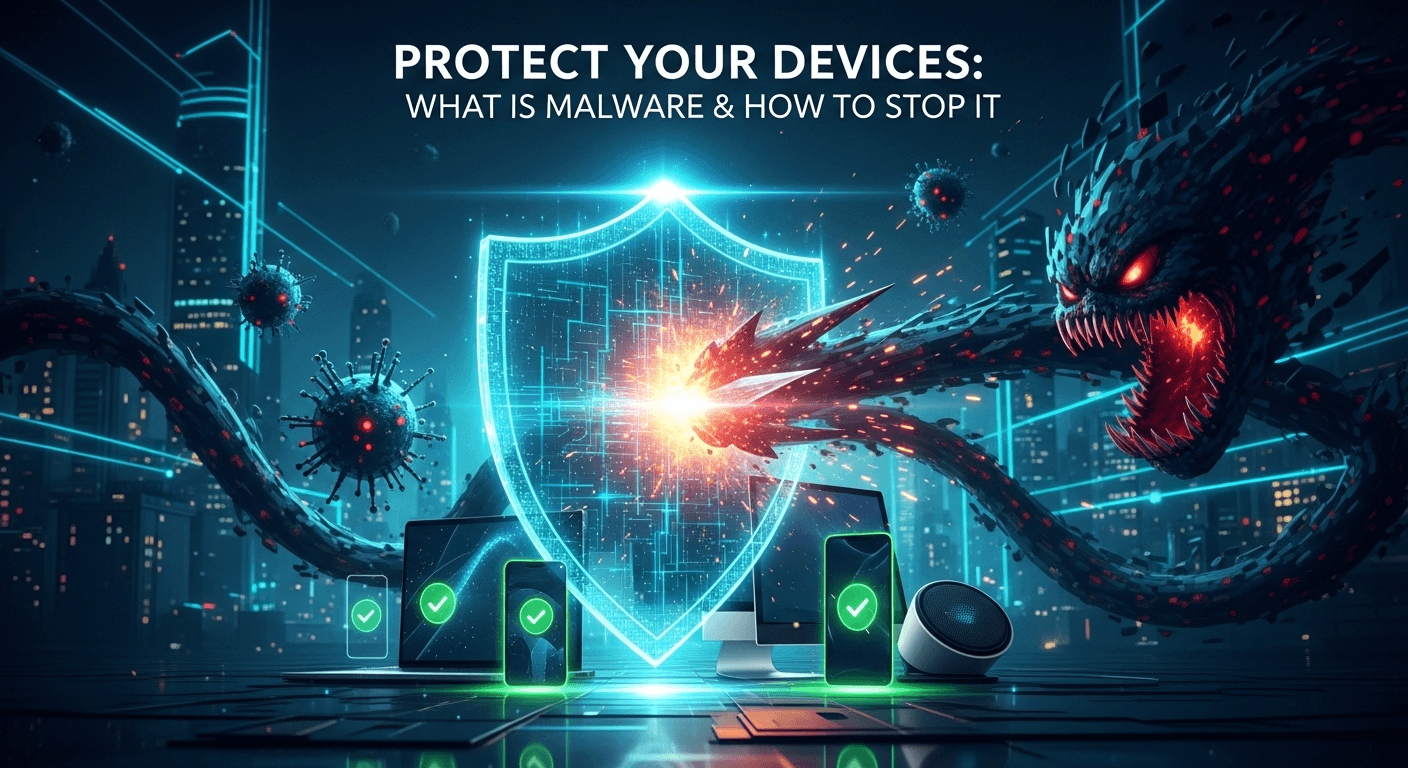
The article, “Protect Your Devices: What Is Malware & How to Stop It,” provides a comprehensive guide to understanding and defending against malicious software. It defines malware as any software created intentionally to cause harm and explains that it is a broad category including viruses, worms, Trojans, ransomware, and spyware. The piece details common ways devices get infected, such as through phishing emails, malicious downloads, and unpatched software vulnerabilities. To prevent infection, the article recommends a multi-layered approach: using reputable antimalware software, keeping all systems updated, practicing safe browsing, being skeptical of unsolicited messages, and securing accounts with strong passwords and two-factor authentication. Finally, it outlines the signs of an infection and emphasizes that continuous vigilance is the best defense in today’s digital world.